

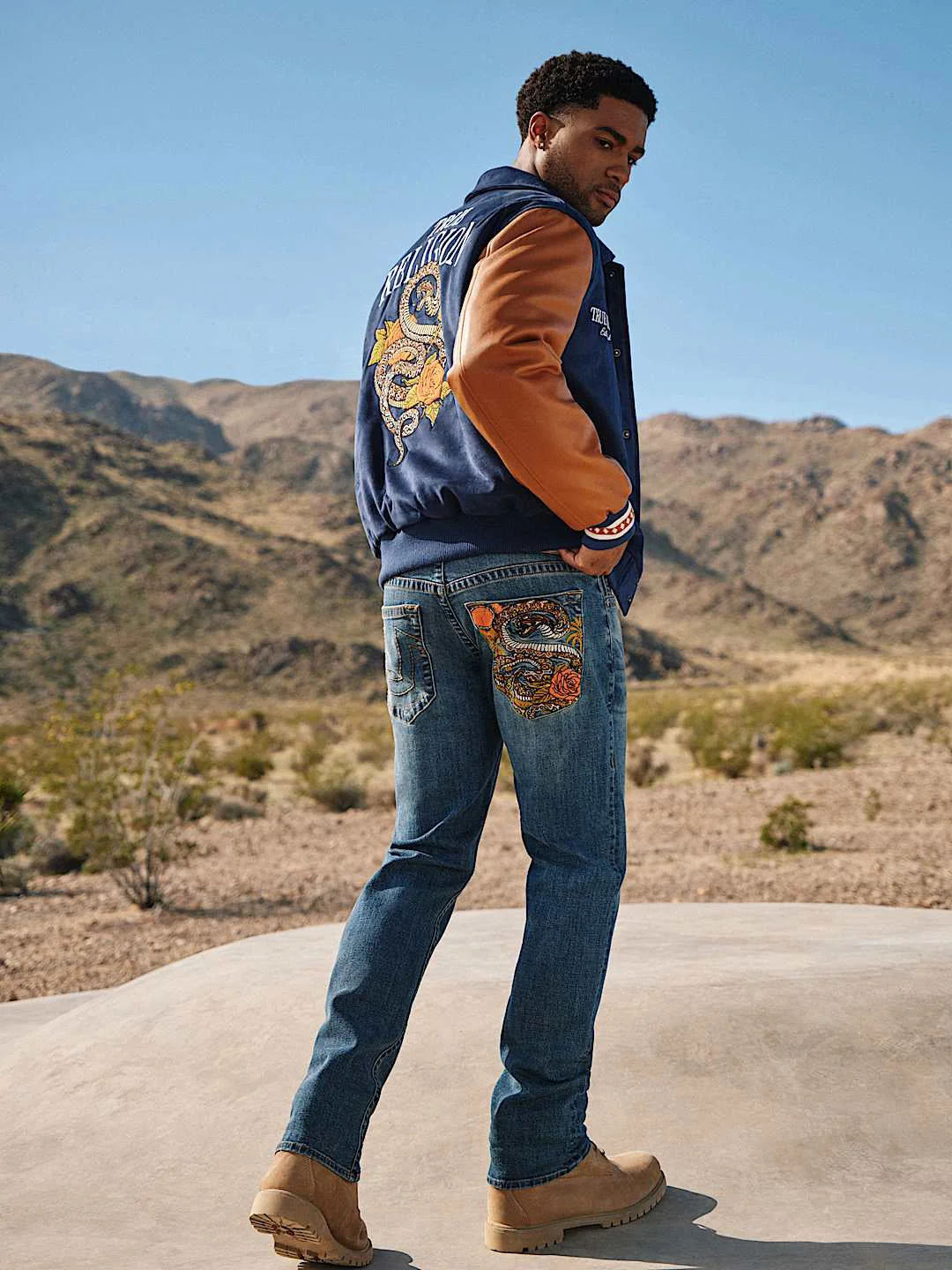
Most people’s jeans problems aren’t a sizing problem. They’re a rise problem, or a rules problem — applying one decade’s fit logic to a completely different silhouette and wondering why nothing looks right. There’s no single correct fit for jeans, because “correct” depends entirely on which jean you’re wearing. What there is, instead, is a set of fit signals that tell you whether the pair in front of you is actually working, regardless of which silhouette it belongs to.
The waistband should sit still. Whatever the rise — low, mid, or high — a waistband that gaps at the back when you sit, or digs in and rolls over when you stand, is the wrong size before anything else about the fit gets debated. This is the one rule that doesn’t bend by silhouette: a waistband’s job is to stay where it’s put, not to be adjusted every time you move.
The crotch seam tells the truth. A seam that hangs too low reads instantly as either an oversized styling choice or a mistake, and the difference between those two is entirely about whether the rest of the outfit is in on the joke. A seam that’s too high cuts into the body and restricts movement in a way no amount of stretch denim fully solves. On a well-fitted jean, that seam should sit close to where your own legs actually meet, with maybe an inch of ease — not draped, not straining.
Skinny jeans should have zero excess fabric, and zero compression lines. The test isn’t whether they’re tight — they’re supposed to be — it’s whether the denim moves with the leg or fights it. Horizontal creasing behind the knee when you’re standing still is the tell that a “fitted” jean has actually become a size too small.
Straight and relaxed jeans are supposed to skim, not cling. The leg should fall in roughly the same line from hip to hem without pulling taut anywhere along the thigh. If you can pinch more than about two inches of fabric on either side of the leg, that’s not a straight leg anymore — that’s a wide leg wearing a straight leg’s name tag.
Wide and baggy jeans are the one silhouette where “too big” isn’t really a fit failure — until the waist goes with it. Volume through the leg is the entire point; a gaping waistband is not. The rise still has to hold, even when everything below it is deliberately loose. That distinction is what separates a considered wide-leg jean from a pair that’s simply too big.
Length is a finishing move, not an afterthought. A hem that breaks correctly for the shoe it’s paired with does more to make a fit look intentional than almost anything else on this list — a slight break for a sneaker, a fuller stack for a boot, a cropped hem that stops clean above the ankle for anything delicate. The same pair of jeans can look expertly tailored or slightly off depending entirely on where the denim ends.
The through-line across every silhouette is the same: fit isn’t about how much or how little fabric there is. It’s about whether the jean is doing what its own shape promises — a skinny jean that actually skims, a wide leg that actually holds at the waist, a straight leg that actually falls straight. Get that right and the size on the tag stops mattering nearly as much as people think it does.