

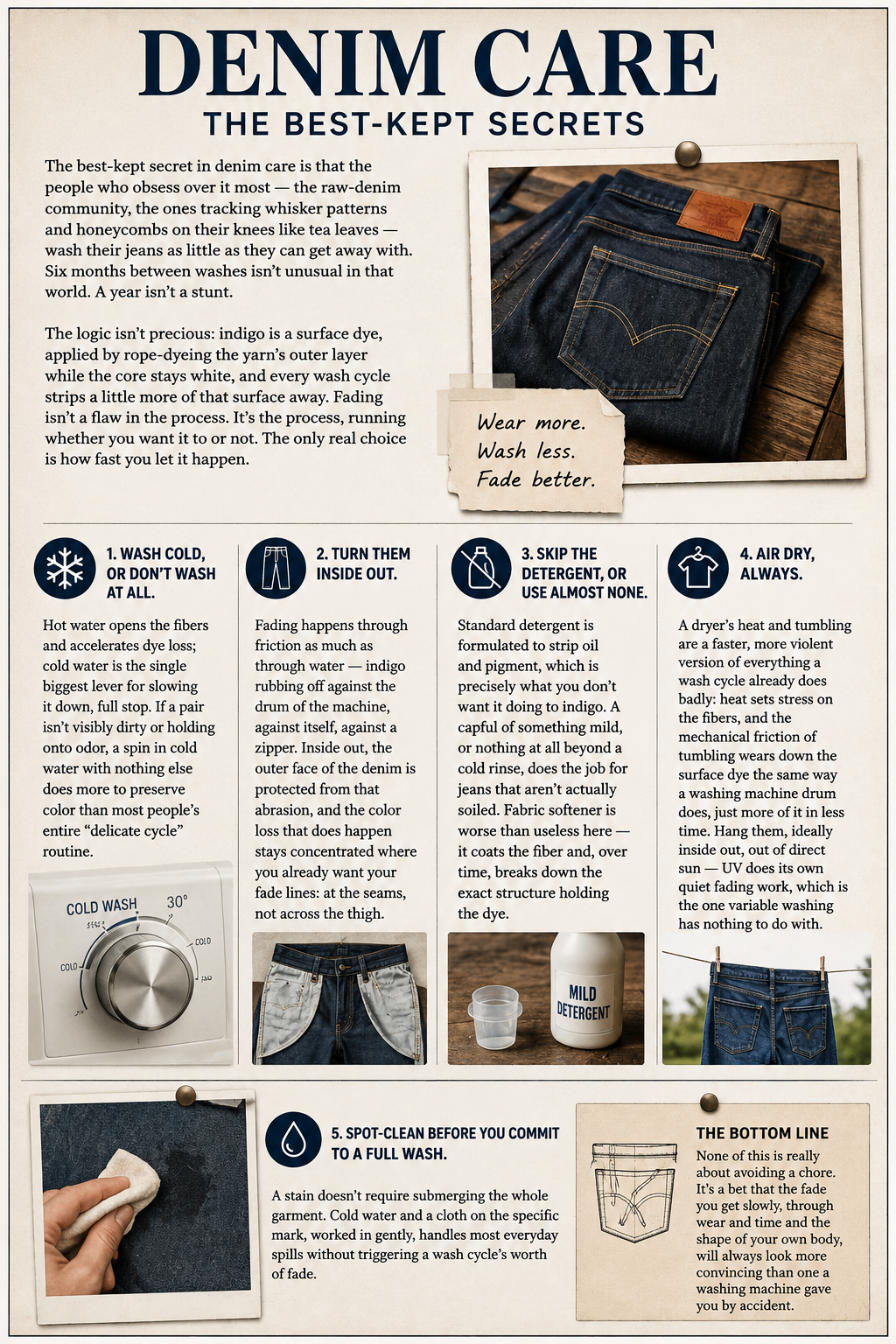
The best-kept secret in denim care is that the people who obsess over it most — the raw-denim community, the ones tracking whisker patterns and honeycombs on their knees like tea leaves — wash their jeans as little as they can get away with. Six months between washes isn’t unusual in that world. A year isn’t a stunt. The logic isn’t precious: indigo is a surface dye, applied by rope-dyeing the yarn’s outer layer while the core stays white, and every wash cycle strips a little more of that surface away. Fading isn’t a flaw in the process. It’s the process, running whether you want it to or not. The only real choice is how fast you let it happen.
Wash cold, or don’t wash at all. Hot water opens the fibers and accelerates dye loss; cold water is the single biggest lever for slowing it down, full stop. If a pair isn’t visibly dirty or holding onto odor, a spin in cold water with nothing else does more to preserve color than most people’s entire “delicate cycle” routine.
Turn them inside out. Fading happens through friction as much as through water — indigo rubbing off against the drum of the machine, against itself, against a zipper. Inside out, the outer face of the denim is protected from that abrasion, and the color loss that does happen stays concentrated where you already want your fade lines: at the seams, not across the thigh.
Skip the detergent, or use almost none. Standard detergent is formulated to strip oil and pigment, which is precisely what you don’t want it doing to indigo. A capful of something mild, or nothing at all beyond a cold rinse, does the job for jeans that aren’t actually soiled. Fabric softener is worse than useless here — it coats the fiber and, over time, breaks down the exact structure holding the dye.
Air dry, always. A dryer’s heat and tumbling are a faster, more violent version of everything a wash cycle already does badly: heat sets stress on the fibers, and the mechanical friction of tumbling wears down the surface dye the same way a washing machine drum does, just more of it in less time. Hang them, ideally inside out, out of direct sun — UV does its own quiet fading work, which is the one variable washing has nothing to do with.
Spot-clean before you commit to a full wash. A stain doesn’t require submerging the whole garment. Cold water and a cloth on the specific mark, worked in gently, handles most everyday spills without triggering a wash cycle’s worth of fade.
None of this is really about avoiding a chore. It’s a bet that the fade you get slowly, through wear and time and the shape of your own body, will always look more convincing than one a washing machine gave you by accident.