

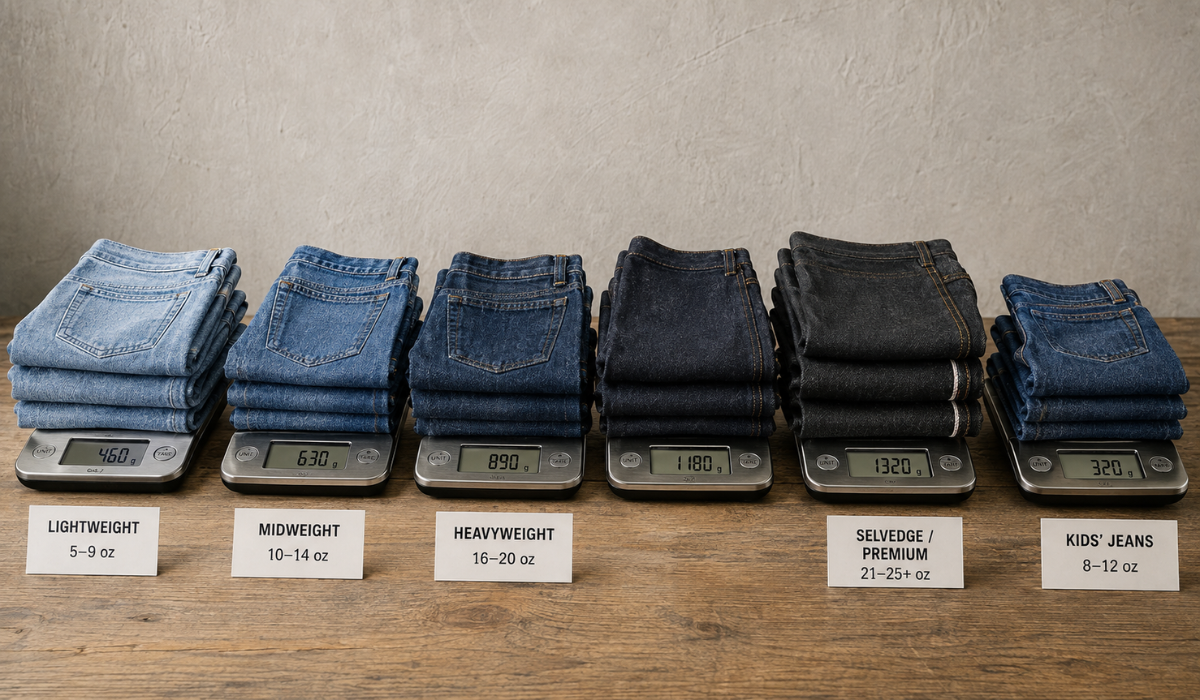
I actually started wondering about this because I was packing for a trip a few months back, threw three pairs of jeans in my bag without thinking twice, and then my suitcase came in almost 4kg heavier than I expected at check-in. Denim is sneaky like that. It doesn’t look heavy folded up in a drawer, but pick up a stack of it and suddenly you get it.
Quick answer, since I know most people just want the number: a typical pair of jeans weighs somewhere between 1 and 2.5 pounds, or 450 grams to about 1.1 kilograms if you’re working in metric. If I had to pick one “average” number, I’d say around 600-700 grams for most everyday jeans. But that’s really just a starting point — the actual weight depends on a handful of things, and honestly some of them surprised me when I looked into it.
So Why Isn’t There Just One Answer?
Here’s what I didn’t realize before digging into this: denim isn’t really “one fabric.” It’s more like a whole spectrum, and jeans made from different points on that spectrum can weigh almost double each other even in the same size. A few things drive that.
The denim’s own weight (oz or GSM): You’ve probably seen tags that say something like “12 oz denim” and wondered what that even means. It’s not the weight of the finished jeans — it’s how dense the raw fabric is per square yard. Light stuff is around 5-9 oz. Your basic everyday jeans usually sit in the 10-14 oz zone. Anything heavier than that, especially past 16 oz, starts getting into raw denim and workwear territory, and some of the heavy selvedge stuff goes past 20, even 25 oz. For reference, 1 oz per square yard is roughly 34 grams per square meter, if you’re trying to do the math yourself.
Size, obviously: Bigger size = more fabric = more weight. Not exactly groundbreaking, but the gap is bigger than you’d guess. Between a small and an XL in the same style, you could be looking at 300+ grams of difference.
The cut matters more than I thought: A wide-leg or relaxed pair just eats up more fabric than a skinny cut, even using the exact same denim. So don’t assume “same brand, same weight denim” means “same weight jeans” — the silhouette changes things too.
Hardware adds up: Rivets, buttons, zippers, extra pocket layers, reinforced seams — none of these weigh much on their own, but stack them together on a heavier pair and it’s a real few ounces.
What’s actually in the fabric: Pure cotton denim weighs more than the stretchy stuff blended with elastane or polyester. This is honestly the biggest reason women’s jeans tend to weigh less on average — a lot of them use stretch blends that are lighter by design, not just cut smaller.
Whether it’s been washed or treated: Stonewashing and enzyme washes actually break down and remove a bit of fiber during processing. So a stonewashed pair usually weighs a little less than the same jeans left raw.
A Rough Weight Chart
I put this together as more of a reference point than a hard rule — brands vary a lot even within the same category.
| Jeans Type | Denim Weight (oz/yd²) | Approx. Weight (grams) | Approx. Weight (lbs) |
|---|---|---|---|
| Lightweight / summer jeans | 5-9 oz | 350-550 g | 0.8-1.2 lb |
| Midweight jeans (everyday wear) | 10-14 oz | 550-750 g | 1.2-1.6 lb |
| Heavyweight / raw denim | 16-20 oz | 800-1,000 g | 1.8-2.2 lb |
| Selvedge / premium heavyweight | 21-25+ oz | 1,000-1,400 g | 2.2-3.1 lb |
| Average men’s jeans | ~12-16 oz | 650-800 g | 1.4-1.8 lb |
| Average women’s jeans | ~10-14 oz | 400-650 g | 0.9-1.4 lb |
| Kids’ jeans | ~8-12 oz | 250-400 g | 0.6-0.9 lb |
Don’t treat these numbers as exact — I’ve seen two “midweight” jeans from different brands land 150 grams apart.
Men’s vs Women’s Why the Gap?
This part actually surprised me a bit. Men’s jeans run heavier on average, usually somewhere around 650-800 grams. Makes sense once you think about it — wider legs, bigger pockets, sturdier hardware, and they’re way more likely to just be plain 100% cotton denim instead of a stretch blend.
Women’s jeans lean the other way. Most have some elastane or polyester mixed in for stretch, and the cuts use less fabric to begin with. End result: women’s jeans usually come in about 20-30% lighter than a comparable men’s pair, often landing somewhere between 400 and 650 grams.
If You Want the Real Number, Just Weigh Them
All these averages are fine, but if you actually need an exact figure — say you’re shipping something or trying not to blow past a suitcase weight limit — just weigh the jeans yourself. Takes two minutes.
- Make sure they’re dry. Wet denim holds water like crazy and will throw the number way off.
- Check every pocket. People forget about that little coin pocket and it does add up.
- Put them on the scale alone, nothing else on there.
- Comparing a few pairs? Weigh them all the same way so it’s a fair comparison.
I do this now before shipping anything denim-related — saves me from guessing wrong on postage.
Why Any of This Actually Matters
I’ll admit, this felt like trivia to me at first too. But it comes up more than you’d think:
- Shipping stuff. If you’re mailing jeans — selling online, sending a return, whatever — an accurate weight matters for postage, especially with international shipping where weight-based pricing gets expensive fast.
- Packing a suitcase. Denim eats into your baggage allowance faster than almost anything else you’d pack. Learned that one the hard way.
- Doing laundry. Denim absorbs a ton of water, so throwing too many pairs into one wash load can mess with how clean they actually get, plus it’s rough on the machine.
- The bigger picture. Fabric weight ties into production costs and shipping emissions too, which is part of why some denim brands now put the oz/yd² right on the label.
Frequently Asked Questions
How much does a standard pair of jeans weigh in kg?
Usually between 0.45 kg and 1 kg. Most everyday midweight jeans fall around 0.6-0.75 kg.
Does heavier denim mean better quality?
Not automatically. Heavier denim tends to be more durable, which is why it’s popular for workwear, but a lot of people (myself included) find midweight denim, around 10-14 oz, the most comfortable for daily wear without sacrificing durability.
Why do jeans feel so much heavier when they’re wet?
Denim is tightly woven and soaks up water easily. A pair that’s 700 grams dry can go past a kilogram once soaked, which is also why they take forever to dry compared to thinner fabrics.
Does the weight of jeans affect what it costs to ship them?
Yes, and it can be more significant than you’d expect. A lot of couriers charge by actual or dimensional weight, so one heavyweight pair can sometimes cost more to ship than two lighter pairs combined.
How much do kids’ jeans weigh?
Generally 250-400 grams, depending on the age/size and how heavy the denim is.
What’s the difference between “14 oz denim” and the actual weight of the jeans?
The ounce rating describes the raw fabric’s density per square yard, not the finished garment. So 14 oz denim jeans don’t weigh 14 ounces — the final weight also depends on the size, cut, and hardware used.
Are raw or selvedge jeans always the heaviest?
Usually, yeah. They tend to use thicker fabric that hasn’t been through weight-reducing wash treatments, so they typically sit at the heavier end compared to stonewashed or pre-washed jeans.
Bottom Line
There’s no one “correct” answer here — it really does depend on the denim, the size, the cut, even the wash. But if you need a ballpark: expect somewhere between 1 and 2.5 pounds (450g to 1.1kg), with most everyday jeans landing around 1.3-1.5 pounds. And if you need the exact number for shipping, packing, or laundry — skip the estimating and just put them on a scale.
 Misty Severi